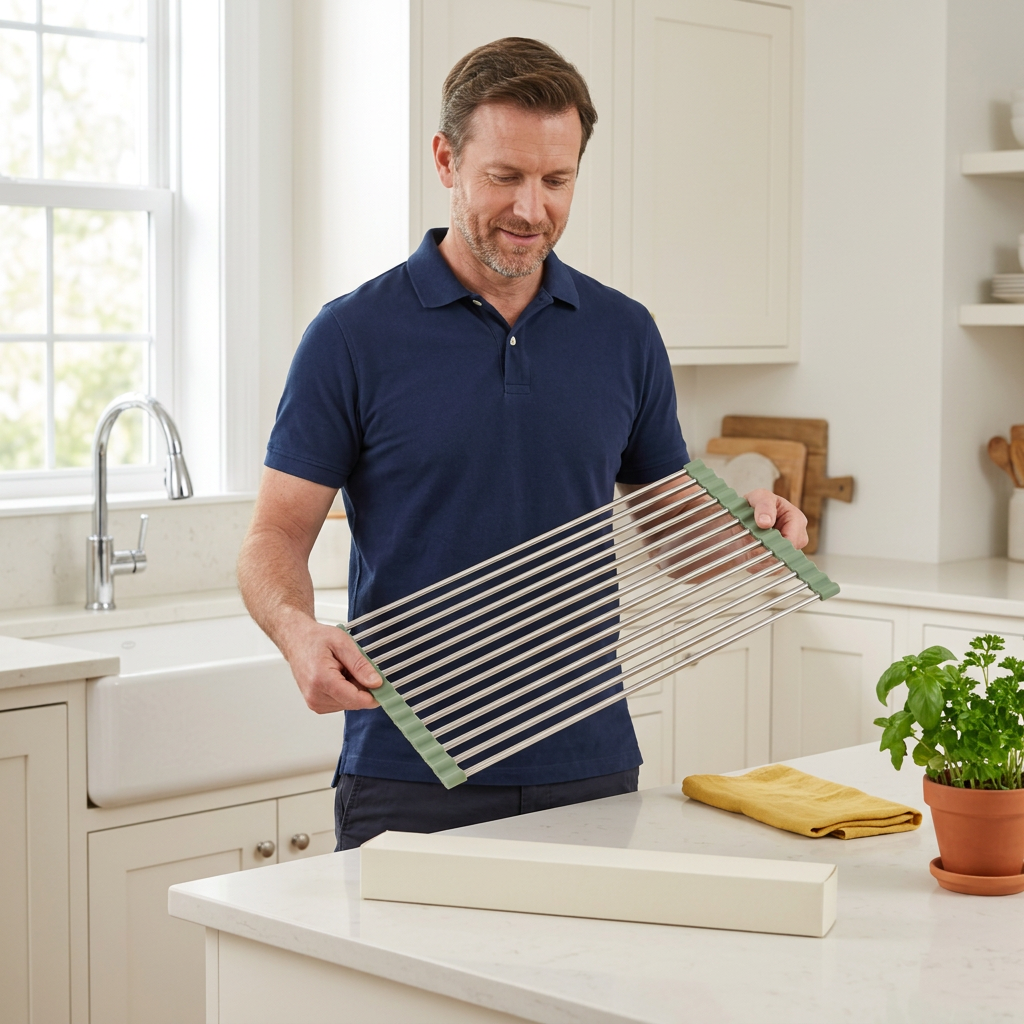
Sage Green & Silver Roll-Up Over-the-Sink Drying Rack — A Removable Draining Surface for Suitable Cups, Kitchenware & Rinsed Produce
Sage Green & Silver Roll-Up Over-the-Sink Drying Rack — A Removable Draining Surface for Suitable Cups, Kitchenware & Rinsed Produce
Couldn't load pickup availability
🫧 A Small-Kitchen Guide to Making Room
Some kitchen tools need a permanent home. Others work best when they can appear for a task, then disappear when that task is finished. This roll-up drying rack belongs to the second idea: a removable surface that sits over a suitable sink for draining, then rolls together for storage.
The pictured design pairs straight silver-colored rods with sage-green connecting rails at both ends. Open spaces between the rods allow drips to pass through rather than collecting on a solid platform. The result is a simple layout with no tall frame, separate basket, or deep tray in the product concept shown.
It is an alternative way to arrange the washing-up area, not an invitation to pile more onto it. Start with the right fit, keep the load appropriate to the verified product instructions, and bring the surface out when you need it.
First, Look at the Space You Already Have
A countertop can fill quickly between preparing food and washing up. A rinsed cup needs somewhere to drain. Vegetables wait beside the chopping board. A drying cloth takes up the corner you planned to use next. Sometimes the useful space is not another section of counter, but the area above a compatible sink.
This rack is intended to bridge that opening with its two end rails resting on stable, opposing support surfaces. Water can then drip into the basin below. Unlike a freestanding countertop rack, it does not need its own collection tray for that arrangement, although any water outside the sink still needs to be wiped away.
It is not a universal fit. The distance between support edges, the shape of the sink rim, nearby fittings, and the available resting area all matter. Treat the photographs as examples of an arrangement, not proof that your sink has the same geometry.
📏 Fit Comes Before the First Cup
Measure the span, not just the basin name
Measure the opening in the direction the rods will bridge, including the stable areas where each end rail will rest. Compare those measurements with confirmed product dimensions and the supplier's required support overlap. Exact rack dimensions are not yet verified for this development concept.
Check both resting surfaces
Both end rails need secure support. Do not balance one end on a narrow edge while the other hangs over the basin, and do not assume a rounded or sloping rim is suitable. A sink with a raised lip or nearby accessory may require a different arrangement or may not be compatible at all.
Leave the working area usable
Check that the faucet can move without catching the rack or anything resting on it. Leave access for the washing task you are doing, and remove the rack if it obstructs safe use of the sink. This is a temporary draining surface, not a replacement for a properly supported worktop.
Three Moments When a Removable Surface Makes Sense
After a quick wash-up
Place suitable lightweight cups or small kitchenware so they rest securely across the rods, subject to the final load guidance. Keep the arrangement simple and avoid stacking unstable items. Smaller pieces that can slip through the gaps belong in another suitable holder; this rack does not include a cutlery basket.
Let water drain into the basin, then put the items away once they are ready. Drying time will vary with the item, placement, and room conditions. No rapid-drying or complete-drying performance is promised.
Between rinsing and chopping
The produce scene shows whole tomatoes and a pepper resting on the rack. For suitable produce, a temporary draining area can help separate the rinsing stage from the chopping area. Keep the surface clean and follow appropriate food-handling practices.
Do not treat the open rods as a chopping board or a surface for loose, tiny ingredients. Food-contact suitability must be confirmed for the final supplied materials before direct food use. The photographs illustrate the intended concept, not a material certification.
When you want the sink clear again
Remove everything from the rack first. Lift it away from the sink, clean and dry it as directed, and roll it together from the side. The metal rods remain straight while the connecting end sections curve around the roll. The idea is to reduce the footprint of the flat arrangement for storage, not to bend or shorten the rods.
A rolled rack still needs space along the full rod length. Check the shelf or drawer you plan to use rather than assuming it will fit into any small compartment.
Details That Keep the Look Simple
The silver-colored rods run in one direction with consistent spacing, creating an uncluttered surface. Muted sage rails give the two ends a coordinated finish, adding a quiet color accent beside pale counters, wood cabinetry, or brighter towels.
The low-profile arrangement shown has no upper tier, utensil cup, or separate plate slots. That makes the visual purpose easy to understand, but it also means dishes must be placed so they are stable without those additional supports. It is not designed in this concept to hold plates upright in individual compartments.
The product is pictured with plain cream-colored rectangular packaging without a logo or printed slogan. Food, cups, towels, and other styling items are separate accessories and are not included.
🧽 Finish With a Clean Surface
Remove food particles and residue after use, including around the points where the rods meet the end rails. Clean according to the final supplier instructions, rinse as appropriate, and allow the rack to dry before rolling it for storage. Wipe the sink supports and surrounding counter as part of the same routine.
Do not assume dishwasher suitability or resistance to every cleaning chemical. The exact metal grade, rail composition, corrosion performance, and care compatibility are not yet confirmed. Avoid making the rack a permanent resting place for wet items without checking and cleaning underneath it.
What This Rack Is Not
It is not a load-bearing shelf, a seat, a chopping platform, a child-safety barrier, or a support for leaning on. No numerical weight capacity has been verified. Do not use it for heavy cookware or stacked dishes without the supplier's explicit guidance.
It is also not presented as a trivet, oven accessory, or heat-protective mat. Keep hot cookware and direct heat away unless the final product has verified instructions supporting that use. A metal appearance does not establish a safe temperature rating.
Included, Without the Extras
One roll-up drying rack in the sage-green and silver-colored design shown. The concept has two connected end rails and parallel rods; it does not include a drain tray, plate holder, utensil basket, cookware, or food.
Make Room, Then Take the Space Back
A useful kitchen does not always need more permanent equipment. Sometimes it needs a surface for one stage of a task, and the flexibility to put that surface away afterward. Bring a little more intention to your sink area with a coordinated rack that follows that rhythm.
Choose your roll-up draining companion, US$24.99.

Sage Green & Silver Roll-Up Over-the-Sink Drying Rack — A Removable Draining Surface for Suitable Cups, Kitchenware & Rinsed Produce